
It’s very rare I give up on a book. Even if I’m not liking it straight away, I tend to stick with it. Sometimes it pays off and other times, it doesn’t. I’ve considered the fact there is an abundance of good books in the world and not enough time to read them. So, why waste my time reading something I don’t like? Many readers can relate to the ever growing to-read list and never getting a chance to read those books bought several months or even years ago, so there really isn’t any time to waste. That’s not to say I haven’t put down a book I didn’t like, but maybe this is something I should do more often.
I also wondered if other people had the same problem as me. Or if what I’m describing is even a problem at all. So, I turned to the good people of Mastodon to see if they stick with or quit a book they aren’t enjoying.
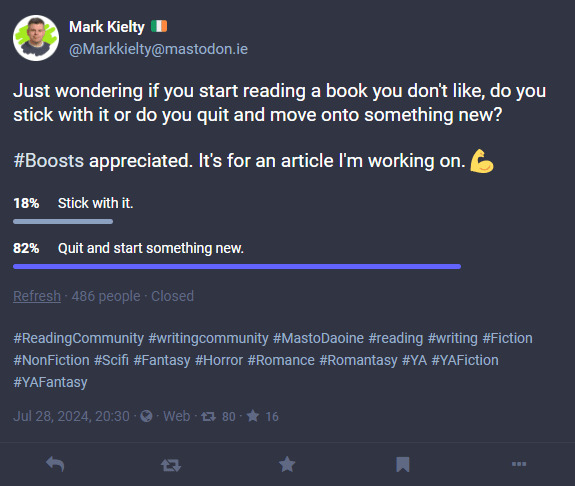
Firstly, I didn’t think this poll would take off the way it did. As you can see, 486 people took part in the poll and it was boosted (re-posted) 80 times. Given the amount of followers I have on the platform, this was more engagement than I could’ve predicted. Thanks to everyone who took part, shared, and boosted the three-day poll.
When asked if they quit and start something new or stick with a book they don’t enjoy reading, 82% of people said they would quit whilst 18% said they would stick with it. So, if you ever felt guilty about not finishing that book you thought was a slog, don’t! Because as you can see, there’s nothing to feel guilty about – you’re in good company.
I wondered why people answered the poll the way they did, and luckily for me, I didn’t need to ask. Lots of people expanded on their vote in the comments and the poll conjured up a lively conversation which included people from the stick with it camp, the quitting camp, and a few people who identified as a bit of both. You can find the poll here.
From reading the comments and looking at the poll, here are five things I learned you should consider before quitting that book you’re not enjoying.
1. What is your motivation for reading the book?
One of the questions that arose in the comments was whether we were talking fiction or non-fiction books. I purposely didn’t specify because I wanted all kinds of readers to take part in the poll. There are readers out there who would lean toward one over the other and vice versa. But it also triggered the question around motivation when reading certain types of books. Sometimes reading a book isn’t about enjoyment. It could be, for example, to gain knowledge.
I remember completing a diploma in management and naturally I found some subjects more interesting than others. I would love to say I found the book on accounting enjoyable, but I slogged through knowing that the information between the pages would be of benefit to me professionally. The motivation in this case wasn’t enjoyment; it was to gain knowledge to help me improve my job prospects.
As for fiction, I know some people who tried, with varying degrees of success, to read Ulysses by James Joyce. Anyone who has ever tried to read it knows that this is a challenging task. This is not the type of novel you’d normally read at the side of the pool during a relaxing sun holiday. It takes time and effort. Enjoyment might not necessarily be the motivation here, but to learn about the literary nuances Joyce was known for or to be able to say that you read one of the world’s most highly regarded books. It could be that the motivation here is bragging rights.
But generally, fiction is supposed to be entertaining and if it isn’t entertaining you, then is it serving its purpose? Why are we torturing ourselves? Is it a hangover from school where we were encouraged to stick at things we didn’t enjoy so we can learn something when we come out the other side? Having a think about why you’re reading a book may help determine whether you should put it down or stick with it.
2. What headspace are you in when reading that particular book?
I remember listening to the audiobook of Hannah Kaner’s Godkiller and it took me a while to get into it, but it had nothing to do with the book or its writing. It was because of me. I had been recently promoted and I took on a lot more responsibilities than my previous job. There were days I was exhausted travelling to and from work. Not because I was overworked, it’s just the nature of starting new a job. I had a lot to learn and the job at times could be legislatively heavy.
Normally I listen to audiobooks or read on the way to and from work, during the two times of the day when I was most tired. I’d be dozing off and when I came to, I’d have to replay whatever chapter I was on.
But once I got used to my new job, I had a lot more energy and stuck with the book which I really enjoyed. (I will one day post the review here).
Your headspace could also be affected by the types of books you’ve read before. Sometimes books dealing with severe and taxing issues, while important, can have an effect on your mental state. Perhaps you just need a couple of days to digest what you’ve just read before moving onto the next book.
For me, if I read a lot of the same type of book, I want to change it up. I might have read a lot of sci-fi and a few chapters into my next sci-fi book I may put it down and think, you know what? I need a good middle-grade fantasy to cleanse the palate. That doesn’t mean a “no” to the sci-fi book. It just means a “not yet”.
3. Have you considered your own mortality yet when reading?
One thing about this poll, which I hadn’t expected, was that it made me face my own mortality. “Life is too short to read books you don’t like!” is a paraphrased version of what many people said in the comments of the poll. I had people of varying ages admit that they were more willing to stick with a book when they were younger (school age) than they are now. This makes a lot of sense.
When in school, you’re encouraged to stick with things because you may not be at an age or a time in your life where you know what you like or dislike yet. You could hate taking piano lessons at nine-years-of-age, but when you’re fifteen and starting a punk band, you’re grateful that you have some understanding of scales and melody to get you started playing guitar.
But as you get older, you have a better idea of what you enjoy and what you don’t. You also know how long it takes you to read a book or how many books you can read in a year. I bashed into google the question about the average number of books read by a person a year and the number I keep getting is around 12. Given that hundreds of thousands of books are published every year, it doesn’t give us much time to get through the books we may like, let alone the ones we don’t.
You might consider, is my life any better for reading this book? Is this book enriching the short time I have on this earth? If the answer is no, then why read it?
I think the reason this poll resonated with so many people is because of those who will quit and start something new, there was a an epiphany in their lives when they realised, “I don’t need to do this to myself anymore.” I think this poll had more of an existential element to it than I realised.
4. Is the book just bad?
So, there’s a difference between a book you don’t enjoy and a bad book. You may not enjoy listening to Metallica because you don’t like heavy metal, but that doesn’t make the music bad; it just means the music isn’t for you.
But are there basic things about the book that just don’t cut the mustard? Spelling, grammar, poor dialogue? Even the most heavily edited books have the odd typo here or rogue sentence there. But we’re talking consistent mistakes throughout the book.
Characters, as I’ve said in other articles, are the most important aspect of a story – and if the characters are bad (and I don’t mean evil) then you’re in for a slog. Do the characters do something that doesn’t match their personality to advance the plot of the story? Do they feel wooden, unconvincing or unbelievable? Even characters in a fantasy, despite its genre, need to feel real.
If a book is bad, then you’re not getting anything out of it, unless you enjoy bad books, and weirdly some people do. The Room has a cult following despite being a terrible movie. Love-hating is a thing and maybe this is something you enjoy.
5. Have you given the book a fair chance?
In the comments of the poll, people set various rules on how they decide whether to put down that book. Obviously, as one Mastodonian pointed out, you need to go beyond the first sentence to truly give it a chance, even if it doesn’t “hook” you from the start.
But where do you draw the line? At what point have you given the book a fair chance? Well, that’s very much up to you, but the consensus I learned from Mastodon was from one chapter to 50-100 pages. Luckily with e-books, there is an option to preview books before you buy and often it gives you a fair chunk to give you an idea whether you’ll like the book. Of course, you can also do this with physical books if you have the time to read a bit before you buy.
You can also preview books at your local library and if your library is signed up to it, Borrow Box, which is an app that acts as a digital library for e-books and audiobooks. This has been a lifesaver for me on the wallet because it means I don’t have to buy books all the time and yet borrowing books still contributes financially to the author.
There are lots of ways to try books before committing financially, which removes the excuse I once had that, well, I already bought the book, so I better read it to justify the purchase.
Conclusion:
I hope the above gives you food for thought if you’re facing the decision as to whether to put down that book you’re not enjoying. Considering you’re motivation or headspace when reading a book might mean that you’re not saying “no” to a book, but “not yet”. And if this isn’t considered, you might be missing out on a book you would genuinely enjoy or at the very least, get something out of. It’s almost like a, “it’s not you, it’s me” situation. You just need some space.
But what if it isn’t you? What if the book is bad? Unless you like love-hating a book, then you’re not getting anything out of it and if you gave the book a fair chance, then you have nothing to feel bad about when quitting and starting something new.
Like I stated before, with the help of the online community on Mastodon, life is too short to spend on a book you’re not enjoying. Because even if you don’t move onto a new book, there’s plenty of worthwhile things to do in life than read a book you hate.

 MARK KIELTY