

I’ve written quite a few novelettes over the years. They’re longer than short stories but shorter than novellas which was perfect for me when learning how to write. I wrote mine in chapters, so it was basically like writing a mini book. I could write them quickly and get more practice writing beginnings, middles, and ends as well as getting to play around with character and plot without months or years of commitment.
But with my new book coming out, Magical Bounty Hunters, which is a collection of serialised YA fantasy novelettes, I wondered if this format could help combat the decreasing number of young people reading for pleasure.
Young People not Reading for Pleasure:
Over the last number of years, studies have shown that less young people are reading for pleasure across both the UK and Ireland. According to the National Literacy Trust, “Children and young people’s reading for enjoyment is at an all-time low”, (2025);
- Only 1 in 3 (32.7%) children and young people aged 8 to 18 say they enjoy reading in their free time.
- Only 1 in 5 (18.7%) say they read something daily in their free time.
This compared to 58.6% in 2016 where people aged 8 to 18 said that they enjoy reading either very much or quite a lot shows the decline in reading for pleasure over the past ten years.
Children’s Books Ireland have reported similar trends where reading for pleasure dramatically drops when children reach their teenage years, with a sizable chunk of boys not reading for pleasure generally. “24% of Irish teenagers (13–18) and 19% of boys across all age categories are not reading for pleasure.”
They’re both interesting studies so if this is something that interests you, I recommend giving them a read.
Why is Reading Important?
There are a lot of articles and research available when it comes to tracking young people’s reading for pleasure, but why is this important? Is reading not like any other hobby? Some people like it and some people don’t, big deal. But reading has a fundamental impact on our wellbeing which is difficult to ignore. According to Hatchett Learning, these include;
- Significantly larger vocabulary
- Enhanced comprehension skills
- Stronger critical thinking skills
- Greater empathy and compassion
- Stronger imagination and creativity
- Better performance in school assessments across all subject areas, including maths!
- Better cognitive performance and mental wellbeing in adolescence
The National Literacy Trust also expands on this, noting that it helps increase confidence in children as well.
So, if reading is so good for us, why aren’t we doing it more?
Why is this Happening?
There are many reasons why this is happening, but some include:
Time:
Kids these days have a lot going on in their lives. Between school, homework, extra-curricular activities, work and socialising, there doesn’t seem to be a lot of time to read, particularly if you’re tired from doing all the above.
Adults are struggling to find time to read too which is unsurprising. This has a knock-on effect on kids. If they don’t see their parents or other adults in their lives reading, then they’re less likely to read due to lack of reading role models.
Access to books:
According to Children’s Books Ireland, the average book ownership among children in Ireland fell from 30 books in 2023 to 20 books in 2025.
This may feed into another statistic in Ireland where 1 in 5 children under the age of four are not read to. Access to books could be a contributor to this.
In the UK, The National Literacy Trust reports:
- “Our research shows that 1 in 12 (8.6%) children aged 8-18 say they don’t have a book of their own at home, rising to 1 in 8 (12.4%) disadvantaged children.
- 1 in 5 (20%) parents say they are buying fewer books for their children due to the cost-of-living crisis, increasing to 1 in 3 (36.1%) of those who are struggling financially.
- 1 in 7 UK primary schools don’t have a library, rising to 1 in 4 in disadvantaged communities, meaning that 750,000 children are missing out.”
Book ownership is intricately linked to young people reading for pleasure which highlights the importance libraries play in our society.
Technology:
The negative impacts of excessive screen time among children are well documented. According to the HSE, these include a negative impact on:
- language skills
- cognitive skills, for example, issues with attention
- sleep
- relationships
- ability to manage emotions
- fitness levels
Therefore, excessive screen time can reduce the capacity for children to engage with books for pleasure, given the demand for concentration and commitment on the reader.
However, technology can also act as a positive medium in getting teens reading again. According to The National Literacy Trust: “ technology can provide a route into reading for traditionally reluctant less engaged readers. Our research has found that more boys, less engaged readers and children from lower-income backgrounds read fiction on screen.”
Why I Believe Novelettes can Help:
One factor that stands out to me as a reason why both teens and adults don’t read for pleasure is time. I’ve heard of the phrase “time poverty” which basically means we are so preoccupied with daily tasks, we don’t have time to ourselves.
Teens are spending so much of their days in school and completing homework that by the time they participate in extra-curricular activities, work and/or socialising, it leaves very little time to read.
Adults with caring responsibilities, for example, can suffer from extreme time poverty, whether that’s caring for kids or elderly relatives or both. That’s on top of the normal tasks we need to complete such as house chores and going to work.
It is no wonder that sites like TikTok and other short form media is so popular. You have an immediate hit of entertainment in as little as thirty seconds.
But I believe novelettes can help people read for pleasure again. Because they are basically mini books, they can be presented in chapters like regular novels but take a fraction of the time to read. Given how busy our lives are, for both children and adults, if we had access to stories like this, it may encourage us to read more during those short windows of time we have free.
My new book isn’t a novel; it’s a series on novelettes in one book. If we think of novels as movies, then Magical Bounty Hunters will feel like a TV boxset. You can read this book all at once or read a part, take a break, and come back to it later. Like an issue of a comic series or an episode of a TV show, each part is a story in itself.
I think this flexibility can really help those who may suffer from a lack of free time. Firstly, novelettes are less daunting than novels to read. In an hour or two, you could have one story read (start, middle and end), and you will have squeezed reading for pleasure into a busy day or week.
What you’ll find with my book is that you will read this book quicker than you may think. Each story is designed to encourage you to read the next until you’re finished the series. The idea I want to leave with readers is that not all books take a long time to read and I want to encourage them to pick up a novel next. I believe novelettes can build up reading stamina, and help readers realise that novels and other books don’t have to feel discouraging to undertake, even for those who find it challenging to find time to read.
As someone who hadn’t read all that much in secondary school, I think novelettes could’ve helped me read more. They’re less daunting and you can read them in the time it takes for you to get the bus somewhere. They’re also easier to fit around busy schedules while having the satisfaction of reading an entire story during those little gaps of free time we have.
Help children read for pleasure:
Liked this article?
- Please consider donating to Children’s Books Ireland to help children access books and read for pleasure. Ireland
- Please consider donate to the National Literacy Trust today and help empower every child with the literacy skills they need to succeed in life. United Kingdom
Listen to my interview with 92.5 Phoenix FM where I talk about Magical Bounty Hunters and reading habits of young people:
If novels are like the written form of movies, then this will feel like bingeing on your favourite TV show!

When sixteen-year-old Cassie gets kicked out of the Flitterbick School of Magic, she’s sentenced to work as a Magical Bounty Hunter for two years. Sure, they call it an internship, but it’s a punishment rather than a job opportunity.
With the help of her Scottish mentor, Victor, Cassie is launched into the life of a Chaser to reap the magic of criminals, but these aren’t your average magical lawbreakers. From a little old lady on Dublin’s Moore Street to a mob boss from 1920s New York, none of Cassie’s targets are what they seem.
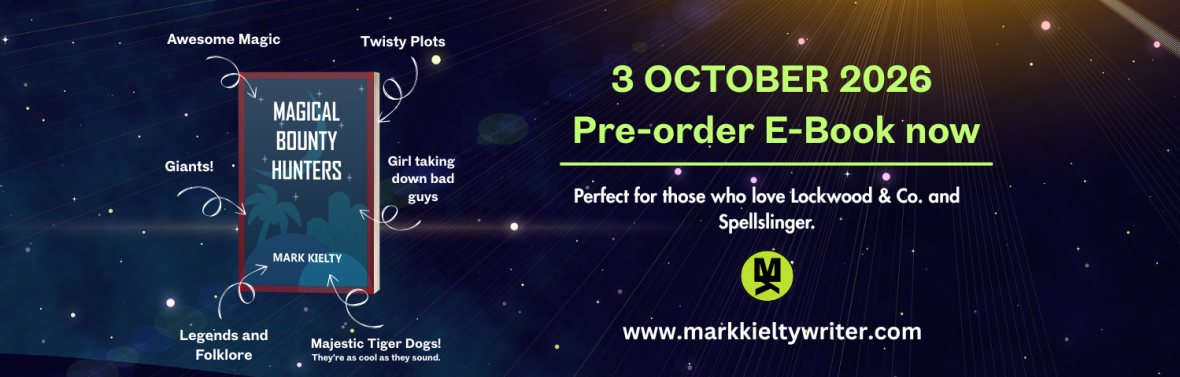
Magical Bounty Hunters includes a series of five YA novelettes taking a teen witch across the world on death-defying missions while she discovers who she is along the way.
This book includes:
- Five stories, one epic series, all in one book.
- Twisty plots.
- Awesome magic.
- Majestic Tiger Dogs! (They’re as cool as they sound).
- Giants!
- Legends and folklore.
- Girl taking down bad guys.
Paperback available on Amazon 3 October 2026
